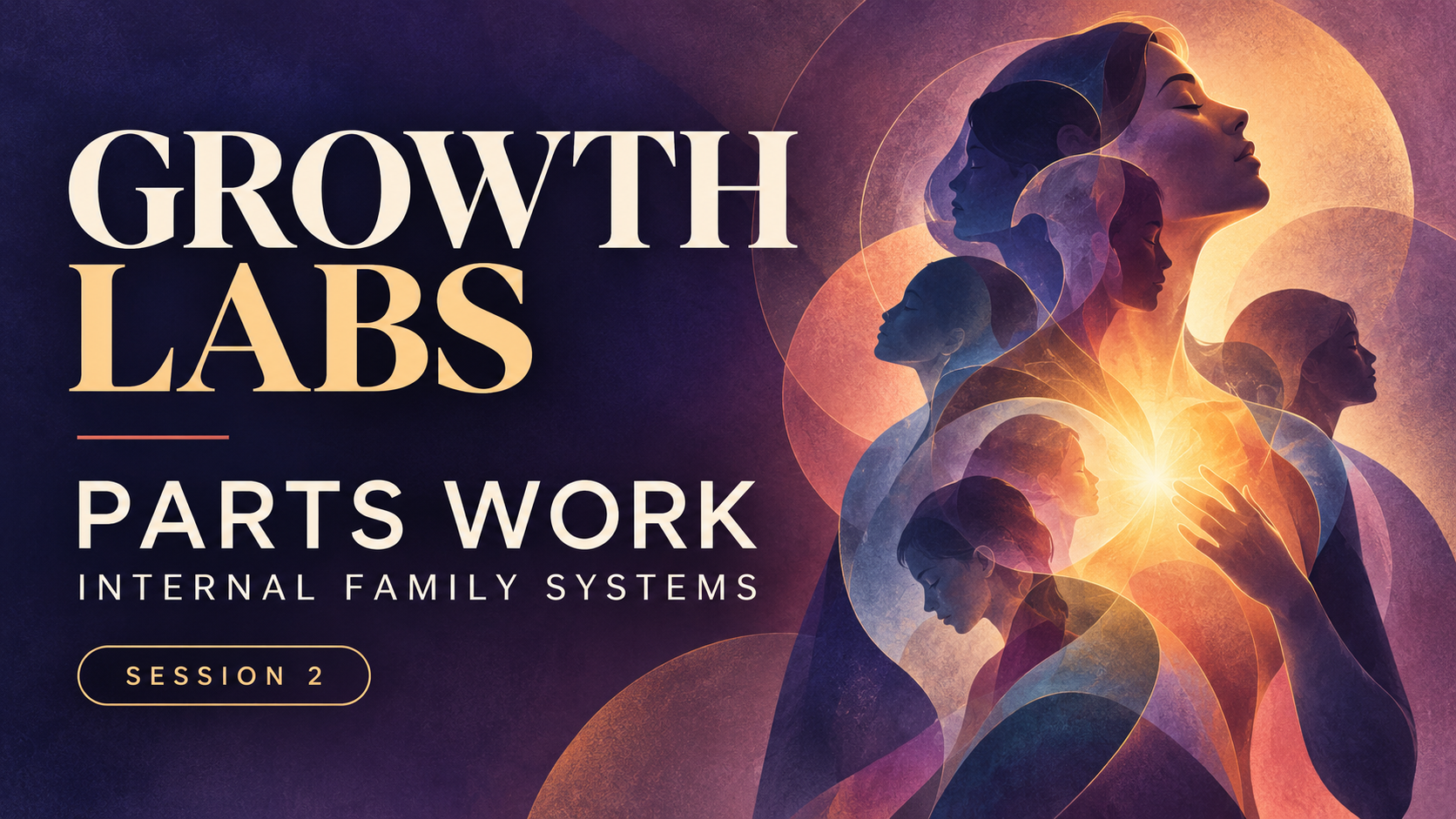
There are no “bad parts” of you.

What might change if, instead of trying to silence the anxious, critical, avoidant, or over functioning parts of ourselves, we turned toward them with curiosity?
We are kaleidoscopic beings. Different parts of us may carry distinct emotions, beliefs, memories, fears, needs, and strategies. One part may long for intimacy while another wants to run. One may recognize the need for rest while another insists we have not earned it.
These contradictions are not evidence that something is wrong with us. Each part developed for a reason, often to help us find safety, connection, belonging, or relief.
MEETING OUR INNER SYSTEM
IFS commonly describes three kinds of protective roles:
Managers work proactively to prevent pain through planning, perfectionism, achievement, caretaking, criticism, or control.
Firefighters respond when pain has already broken through, seeking immediate relief through distraction, numbing, withdrawal, impulsivity, or escape.
Exiles are the young and vulnerable parts carrying experiences such as shame, loneliness, grief, fear, rejection, or the belief that we are somehow not enough.
Even when a part’s strategy creates difficulty, its deeper intention is often protective. Parts work invites us to ask a different question—not “How do I get rid of this?” but “What is this part trying to do for me, and what does it need?”
RETURNING TO SELF
At the center of the IFS model is Self: the grounded, compassionate presence beneath our protective reactions. Self is often described through eight qualities:
Curiosity · Compassion · Calm · Clarity · Courage · Confidence · Creativity · Connectedness
We do not have to manufacture these qualities. We create enough space for what is already within us to emerge.
A simple shift in language can begin that process:
Instead of “I am anxious,” we might say, “A part of me is anxious.”
Instead of “I hate how controlling I am,” we might ask, “What is the part of me that needs control trying to protect?”
That small amount of space allows us to move from identification and judgment toward relationship.
THE BODY AS A DOORWAY
Throughout the session, participants practiced noticing how Self and protective parts appeared in the body: an open chest, rooted hips, a tightening throat, a clenched belly, warmth, contraction, or the sudden impulse to fix, fight, hide, or leave.
These sensations can become invitations to pause.
Feel the support beneath you. Notice your feet on the ground. Let your spine rise. Take a breath. Ask what is present without immediately trying to change it.
During the closing reflection, participants shared how protective armor softened when it was given space, how inner judgment could be recognized as another part, and how grief, rest, visibility, and self-love appeared differently when approached with compassion.
One insight resonated through the conversation: loving ourselves may begin by learning how to be in relationship with all the parts of who we are.
EXPERIENCE PARTS WORK
In our most recent Growth Lab, Emerge founder Maya Lemberg introduced participants to parts work and Internal Family Systems (IFS)—an approach grounded in the understanding that the mind is inherently multiple.
Click the link below to watch an educational groups session in collaboration with Sol Emergence.
Sol Emergence is a nonprofit that creates safe, sober, and supportive events for the Atlanta community, including Sol Dance and Growth Labs, expanding access to experiences that support somatic embodiment and psychological development.
As the founder of Emerge Psychotherapy & Healing and a cofounder of Sol Emergence, Maya brings these two communities together through Growth Labs: a collaborative space for embodiment, psychological insight, and meaningful connection.